Celebrating Amelie’s Promotion & Master Thesis
We’re excited to announce Amelie Pachter’s promotion from Architectural Intern to Architectural Technician!
Amelie joined IA as an intern in May of 2025, simultaneously beginning her work towards a Master of Architecture from Lawrence Technological University (LTU). Following her graduation this Spring, Amelie is now a part of our team full-time, with a goal of licensure in the next two years.
As an Architectural Technician, she will be involved in the details of our projects, from design development to construction documentation. With organizational aptitude and reliable, steadfast efforts, Amelie’s addition forwards our mission of disciplined and impassioned work. Outside of work, she enjoys outdoor hobbies, including hiking and recreational sports. She is also an avid reader and plays the cello.
We are delighted to have Amelie take on this new role and cannot wait to see how her continued growth as an architect leaves an impact at IA and the world around her.
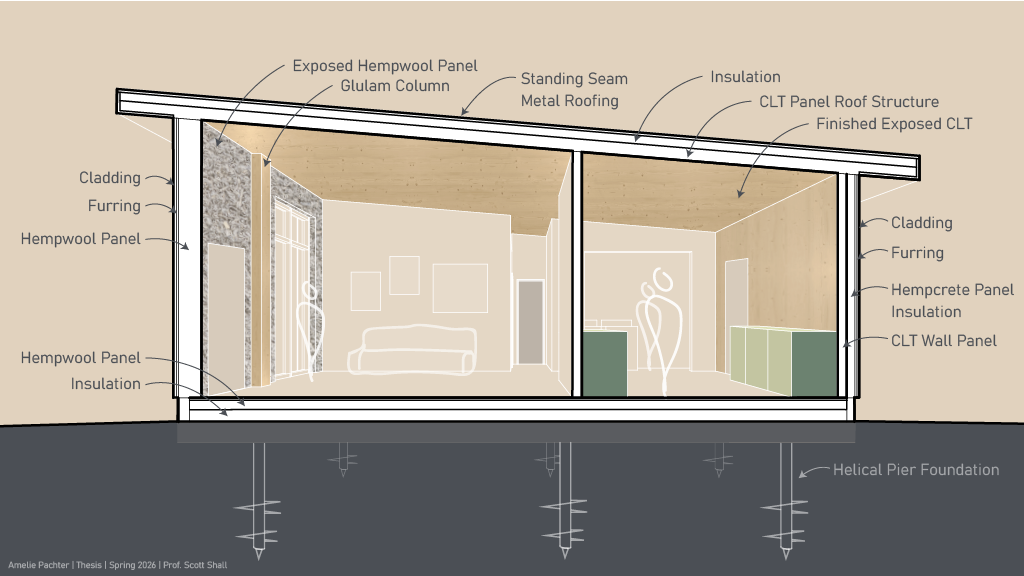
Showcased below is an abstract of Amelie’s Master’s Thesis, a work developed from an innate appreciation for the natural world and a goal of waste reduction in architectural construction. Her thesis provides thoughtful, modular solutions to some of the greatest sustainability challenges the industry faces in building suburban homes.

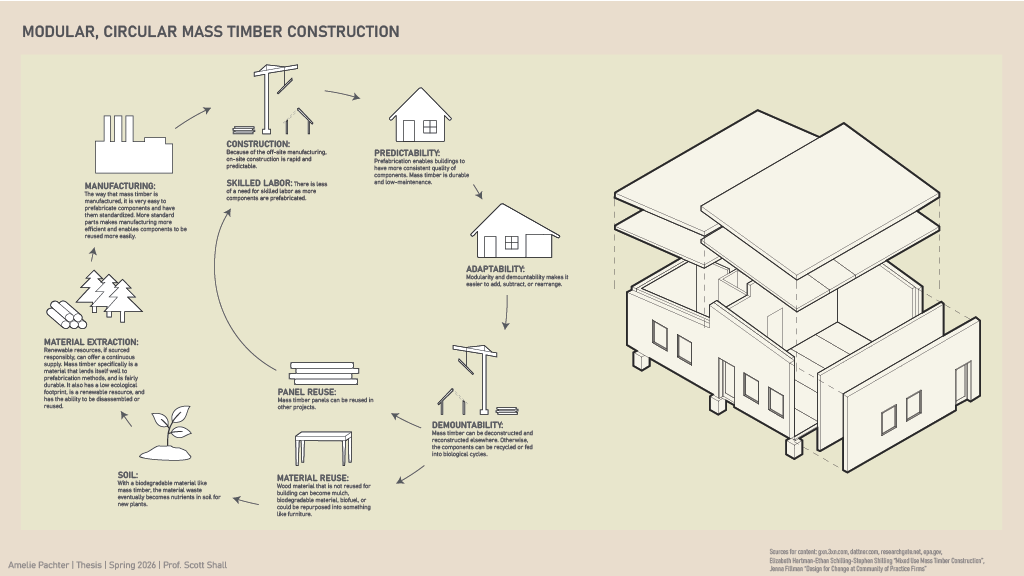
Amelie’s thesis begins by proposing a circular home construction model to combat the effects of construction and demolition waste. Against a linear construction model, circularity would provide a more predictable use of materials and offer adaptability to emergent changes or additions within a project. The model suggests that through the medium of Mass Timber, the connection points of demountability and material reuse are especially fitting. The biodegradable nature of timber ensures an environmentally beneficial approach to waste, while the case of panel reuse can bypass the need for new material extraction entirely.
Further explored were the potential benefits of this model in the prevailing housing crisis. Mass timber modularity reduces on-site construction time and increases efficient manufacturing. In a system so dependent on the coordination of timelines, these factors promote quicker builds and opportunities for additions to preexisting modular structures. Innovating the process to be more affordable would benefit the tenant experience in the face of increased unit demand.
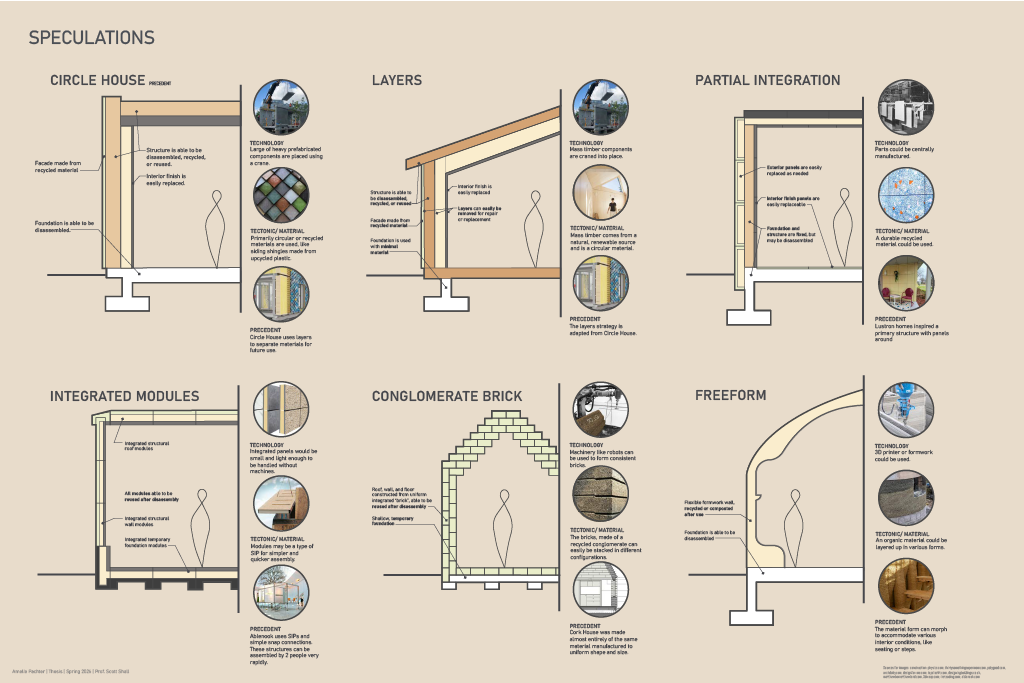
Presented in the form of residential investigations, this thesis also examines modularity in its application to the greater design process. The guiding principles of salvageability, reassembly and efficiency in material use are all verified by precedents such as Circle House in its repeatable parts or Ablenook in its rapid but temporary construction. The project’s series of speculations employs a palette of materials, confirming that style and customization does not have to be the sacrifice of environmentally conscious construction. Additionally, prefabricated options within mass timber offer uniquely adaptable structural framework, making its selection especially efficient in the case and market of housing. The suggested merge of modern CNC machinery with traditional wood joinery presents a case for completely decomposable assemblies. Precision from the production process plays further to cost-reduction and even thermal-bridging. From foundation to framing to exterior finish, a move towards the investigated arrangements ensures lengthened material lifespans and a major reduction in construction waste. These efforts applied in any stage would ultimately help preserve our natural world that supports and inspires great design.